

The bail bond process in Colorado Springs allows a defendant to be released from jail by paying bail or working with a bail bondsman while awaiting court.
When someone is arrested, they are taken to the El Paso County Criminal Justice Center for booking. A judicial officer then sets bail based on risk, charges, and court history. This process is designed to protect public safety while allowing temporary release under set conditions.
We understand this situation can feel overwhelming and urgent. Clear steps and accurate information help families act quickly and avoid mistakes. Continue reading for step-by-step guidance on how bail works and what to expect next.
Key takeaways
When things move fast, it helps to focus on the basics first.
- Most people get a bond hearing within 48 hours
- A bail bondsman can help if full bail is too expensive
- Missing court creates bigger legal problems very quickly
These points come up again and again, especially in urgent situations.
What happens after an arrest in Colorado Springs?
After someone is arrested, everything starts with booking.
They are taken to the El Paso County Criminal Justice Center. There, officers record personal details, take fingerprints, and log the charges. It’s mostly administrative, but it has to be done before anything else moves forward.
Within about 48 hours, the person usually sees a judge or magistrate. This is called a bond hearing.
At that hearing, the court decides:
- Whether the person can be released
- How much bail will be
- What conditions apply
The court looks at things like safety, past history, and whether the person is likely to show up in court.
How is bail amount determined?
Bail isn’t random. Judges follow a structured way of deciding it.
They look at several factors before setting the amount:
- The seriousness of the charges
- Whether the person has missed court before
- Ties to the community, like work or family
- Risk assessments from pretrial services
Someone with strong local ties and no history of missing court may get lower bail, or sometimes no bail at all.
More serious charges, or a history of skipping court, usually lead to higher bail.
What types of bail bonds are available?
There isn’t just one way to post bail. There are a few options, depending on the situation.
| Bond Type | How It Works | Key Consideration |
| Personal Recognizance (PR) | No upfront payment; release based on trust and community ties | Best option for low-risk defendants with strong local connections |
| Surety Bond | Bail bondsman posts full bail for a non-refundable premium (typically 10-15%) | Most common choice; requires a co-signer |
| Cash Bond | Full bail amount paid directly to the court | Full amount refunded after court appearances, minus fees |
| Property Bond | Property value used as collateral instead of cash | Requires sufficient equity; lien placed on property |
Most families end up using a surety bond because it doesn’t require paying the full amount upfront. Each option comes with different requirements and levels of financial risk.
How does a bail bondsman help?
This is where most people turn when bail is too high to pay in full.
A bail bondsman posts the full bail amount for you. In return, you pay a percentage, usually around 10 to 15 percent. That payment is non-refundable. Understanding how bail bonds in Colorado Springs work helps families know what to expect before signing anything.
The process usually looks like this:
- Fill out paperwork
- Provide a co-signer
- Pay the premium (or set up a payment plan)
- The bond is submitted to the jail
After that, the jail begins processing the release.
Companies like Dennis Blackwell Bail Bonds walk families through each step, especially when things feel rushed or confusing.
How long does release take?
This is one part that surprises people.
Even after bail is posted, release is not instant. The jail still has to complete an out-processing procedure.
That usually includes:
- Confirming the bond
- Checking for other holds or warrants
- Returning personal belongings
- Final paperwork
Most releases happen within 2 to 6 hours after bail is accepted. Sometimes faster, sometimes slower depending on how busy the jail is.
What does a co-signer actually do?
A co-signer, also called an indemnitor, takes on real responsibility.
They are not just helping, they are financially tied to the bond.
That means they agree to:
- Make sure the defendant shows up to court
- Cover the full bail amount if the person doesn’t appear
- Stay in contact with the bail agent if problems come up
This isn’t something to take lightly. If the defendant misses court, the co-signer may be responsible for the full amount.
What happens if someone misses court?
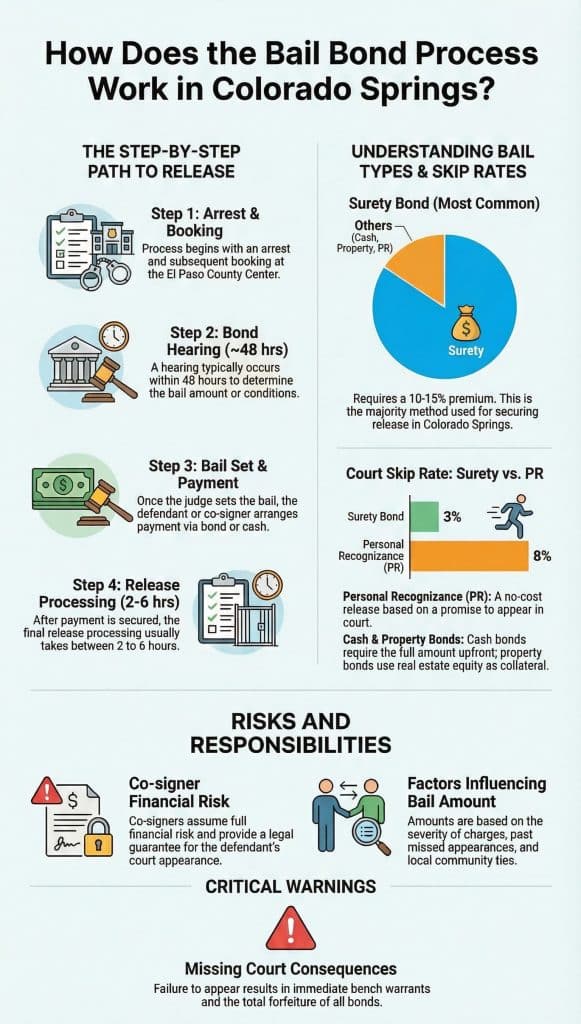
If someone fails to appear, the court can:
- Issue a bench warrant
- Forfeit the bond
- Add new charges
Nationwide data from the Bureau of Justice Statistics shows that among defendants who missed court, those released on a surety bond were substantially more likely to be returned to custody quickly.
According to a comprehensive BJS study covering 15 years of data across the 75 largest U.S. counties, after one year only 3% of people released on a bail bond remained at large, compared to 8% for personal recognizance bonds and 10% for those released through pretrial programs.
In many cases, a bounty hunter or fugitive recovery agent may get involved to locate the person.
Can bail be reduced?
Yes, but it takes a formal request.
If bail is set too high, a lawyer or public defender can file a motion to reduce it.
The court may review:
- Updated personal information
- Community ties
- Willingness to follow stricter conditions
Conditions might include:
- GPS monitoring
- Drug testing
- House arrest
If the court agrees, bail can be lowered to something more manageable.
How do bail bond professionals support families?
When someone is in jail, families usually don’t have time to figure everything out slowly. That’s where a bail bond professional comes in.
Their role isn’t just posting bail. They help guide the process so things don’t get missed.
Most people they work with are dealing with this for the first time, so questions come up right away. A good bail agent helps by breaking things down into simple steps.
The Colorado Division of Insurance, which regulates the bail bonding industry in the state, notes that complaints against agents often involve
“overcharging of premium, misappropriation of premium and collateral, other fiduciary violations and failure to provide required documents”.
This is why working with a licensed, reputable professional matters, they are bound by state oversight and consumer protection laws.
Here’s what that support often looks like:
- Explaining how bail works in plain terms
- Walking through paperwork so nothing is confusing
- Helping set up payment or financing if needed
- Staying available, even late at night
They also help keep things on track after release.
That includes:
- Reminding clients about court dates
- Explaining bond conditions
- Answering questions if something changes
In stressful situations, having someone who knows the system can make things feel more manageable.
What mistakes should families avoid during the bail process?
When things feel urgent, it’s easy to rush. That’s usually when mistakes happen.
One of the biggest mistakes is not fully understanding the responsibility of signing a bond. A co-signer is taking on real financial risk, not just helping out casually.
Other common issues include:
- Not asking questions before signing paperwork
- Missing court dates because of confusion or poor communication
- Waiting too long to act after a missed appearance
- Choosing a bondsman based only on price
Another mistake is assuming everything is done once the person is released. That’s not the case. The court process is still ongoing, and conditions still apply.
Taking a few extra minutes to understand the process can prevent bigger problems later.
What should you expect after release?
Getting out of jail is only the first step.
After release, the defendant must follow all court conditions. These can vary depending on the case, but often include:
- Attending all court dates
- Avoiding certain people or places
- Following restrictions like travel limits
Some cases may also involve:
- Electronic monitoring
- Drug or alcohol testing
- Check-ins with pretrial services
Missing any of these requirements can lead to bond revocation, which means going back into custody.
This is why communication between the defendant, co-signer, and bail agent matters.
How can families stay organized during the process?
Things move quickly, and it’s easy to lose track of details.
A simple way to stay organized is to keep everything in one place. That includes:
- Court dates and times
- Contact information for the bail agent
- Copies of paperwork
Some people use a calendar or phone reminders. That alone can prevent missed court dates.
It also helps to stay in regular contact with the bail bondsman. If something changes, it’s better to deal with it early rather than later.
Make the Bail Process Easier to Handle
When someone is in jail, everything moves fast and it’s easy to feel overwhelmed. You’re trying to understand bail, follow the rules, and avoid mistakes that could make things worse. Missing a step can lead to more stress and delays. It’s a lot.
That’s where Dennis Blackwell Bail Bonds can help. The team guides you through each step so you know what to expect and what needs to happen next.
For families seeking local Colorado Springs bail help, working with an agent who knows the El Paso County system makes a real difference. Dennis Blackwell Bail Bonds helps you stay on track with court requirements and move the process forward quickly. If you need help right now, reaching out is the next step.
Frequently asked questions
How can someone prepare financially before contacting a bail bondsman?
When things happen fast, most people don’t have a plan in place. That’s normal. Still, a little preparation can make the process smoother once you do reach out.
It helps to gather a few basics ahead of time:
- How much money is available right now
- Whether you can use a credit card or payment plan
- Any assets that could be used as collateral, like property
You don’t need everything figured out, but having a rough idea speeds things up.
It’s also smart to think about who could act as a co-signer. This should be someone responsible and willing to stay involved through the process.
When you talk to a bail bondsman, they’ll usually explain the premium (often around 10–15%) and what options you have. Being prepared just helps you move quicker when time matters.
What should families do if they cannot afford the bail amount right away?
This is one of the most common situations people face.
Paying the full bail amount upfront isn’t realistic for many families. That’s exactly why bail bonds exist.
Working with a licensed bail agent allows you to pay a percentage instead of the full amount. In some cases, there may be:
- Payment plans
- Financing options
- Collateral-based arrangements
It’s also worth staying in contact with a lawyer. If bail seems too high, they may be able to request a bond reduction.
The main thing is not to wait too long. The sooner you act, the sooner the process can move forward.
How can someone keep track of court dates after release?
This sounds simple, but it’s where a lot of problems start.
After release, missing a court date can undo everything. So staying organized matters more than anything else.
A few practical ways to keep track:
- Write down every court date clearly
- Set reminders on your phone (multiple if needed)
- Keep all paperwork in one place
Many bail bond companies also send reminders, which helps.
Still, it’s best not to rely on one system alone. Having your own reminders in place reduces the chance of missing something.
What happens if a defendant needs to travel after being released on bail?
Travel is usually restricted, but the exact rules depend on the case.
In many situations, the defendant cannot leave Colorado Springs or El Paso County without permission. Sometimes the restriction applies to the entire state.
If travel is necessary, the safest approach is:
- Review the bond conditions carefully
- Speak with a lawyer first
- Request court approval if required
Leaving without permission can lead to serious consequences, including bond revocation.
It’s always better to ask first than deal with problems later.
How can families support someone after they are released on bail?
Support after release makes a bigger difference than people expect.
The person is often dealing with stress, confusion, and pressure. Having steady support helps them stay on track.
Families can help in simple ways:
- Reminding them about court dates
- Helping with transportation
- Encouraging them to follow all conditions
- Staying in contact with the bail bondsman if needed
It doesn’t have to be complicated. Consistency matters more than anything.
A strong support system reduces the chances of missed court dates or violations. And in this process, avoiding mistakes is just as important as getting released in the first place.
References
- https://doi.colorado.gov/types-of-insurance/bail-bonds
- https://ambailcoalition.org/performance-of-pretrial-release-methods/